2026
– 2028
Development of a Joint Inversion Method for Complete Bouguer Anomaly and Real Vertical Gravity Gradient Data for Subsurface Structural Modeling
This study aims to develop a joint inversion method integrating Complete Bouguer Anomaly (CBA) and real Vertical Gravity Gradient (VGG) data for improved subsurface density modeling. The proposed approach is expected to enhance spatial resolution, reduce model uncertainty, and improve the delineation of shallow geological structures compared with conventional CBA-based inversion.
Overview
The gravity method is widely used in geophysics to model subsurface rock-density distributions through the analysis of variations in the gravitational field. One of the most commonly used parameters in gravity interpretation is the Complete Bouguer Anomaly (CBA), which represents the contribution of subsurface mass variations to the measured gravitational field. However, inversion based solely on CBA data often faces limitations in spatial resolution and uncertainty in delineating relatively shallow geological structures. Consequently, subsurface structural interpretation can be non-unique and unstable.
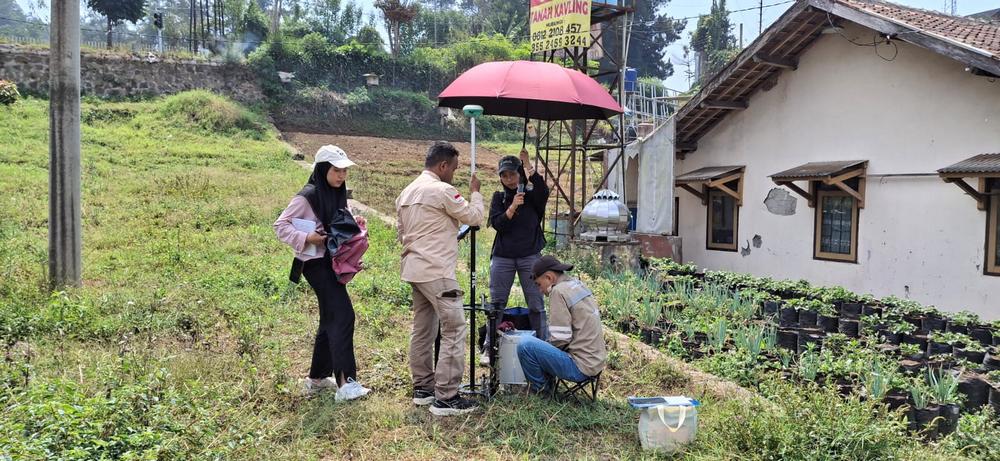
One approach that has the potential to improve interpretation resolution is the use of the Vertical Gravity Gradient (VGG), which is more sensitive to localized density variations. With advances in gravity measurement techniques, it is now possible to obtain real Vertical Gravity Gradient data, in which the gravity gradient is directly measured at multiple observation heights. Such data provide additional and more independent information on the distribution of subsurface mass.
This study aims to develop a joint inversion method that integrates Complete Bouguer Anomaly (CBA) and real Vertical Gravity Gradient (VGG) data within a unified framework for modeling subsurface density distributions. The proposed method will include the formulation of forward modeling for both data types, development of an inversion algorithm, and implementation of regularization techniques to obtain stable model solutions. The method will be tested using synthetic models and observational data to evaluate improvements in model resolution and stability compared with conventional inversion based solely on CBA data.
The expected outcome of this research is a novel method for subsurface structural modeling based on gravity and gravity-gradient data that can improve the characterization of subsurface rock-density distributions. The targeted research outputs are a publication in a reputable Scopus-indexed international journal (Q1) and a Scopus-indexed international conference proceeding. The developed method is expected to contribute to the advancement of geophysical methods, particularly in subsurface structural modeling using integrated gravity and gravity-gradient data.
One approach that has the potential to improve interpretation resolution is the use of the Vertical Gravity Gradient (VGG), which is more sensitive to localized density variations. With advances in gravity measurement techniques, it is now possible to obtain real Vertical Gravity Gradient data, in which the gravity gradient is directly measured at multiple observation heights. Such data provide additional and more independent information on the distribution of subsurface mass.
This study aims to develop a joint inversion method that integrates Complete Bouguer Anomaly (CBA) and real Vertical Gravity Gradient (VGG) data within a unified framework for modeling subsurface density distributions. The proposed method will include the formulation of forward modeling for both data types, development of an inversion algorithm, and implementation of regularization techniques to obtain stable model solutions. The method will be tested using synthetic models and observational data to evaluate improvements in model resolution and stability compared with conventional inversion based solely on CBA data.
The expected outcome of this research is a novel method for subsurface structural modeling based on gravity and gravity-gradient data that can improve the characterization of subsurface rock-density distributions. The targeted research outputs are a publication in a reputable Scopus-indexed international journal (Q1) and a Scopus-indexed international conference proceeding. The developed method is expected to contribute to the advancement of geophysical methods, particularly in subsurface structural modeling using integrated gravity and gravity-gradient data.
Project Information
- Period
- 2026 – 2028
- Status
- Ongoing
- Role
- Researcher
- Institution / Partner
- Institut Teknologi Bandung, BRIN